|
|
|
In-Vitro evaluation of new fiber optic pH,carbon dioxide, and oxygen sensor systems Lawrence S. Ring and Wayne E. Rodgers Lightsense Corporation, Santa Monica, California 90404 ABSTRACT
New fluorescence based disposable probes have been developed for monitoring of pH, Carbon Dioxide, and Oxygen in extracorporeal loops and radial arteries. These low cost, small diameter sensors fit thru most standard female Luer Lock fittings. The portable monitor and its interface to the probes are described. In-vitro performance of the sensor systems vs. tonometered bovine blood and blood analyzer calibration ampules are shown, along with a brief discussion of clinical applications of these devices.
1. Introduction A great deal of time and effort has been expended recently on the development of fiber optic sensors for medical use. Many firms and institutions have been working toward devices capable of replacing intermittent laboratory analysis with continuous bedside patient monitoring. This paper presents the laboratory results of one such development program. 2. Background
Critical care patient monitoring is a vital part of today's health care marketplace. Physicians and staff seek better and faster information about the status of their patients, preferably at a reasonable cost. Top priority is placed on the relatively fast changing parameters related to respiration and blood pressure. The effectiveness of life sustaining critical care treatment depends on their proper maintenance. A few minutes without oxygen (respiration) can cause serious brain damage in normothermic patients. Metabolic changes associated with Carbon Dioxide levels and pH can rapidly result in systemic cellular damage. Finally, changes in blood pressure can cause both oxygen and metabolic level problems due to poor circulation. As a result physicians and critical care staff using todays laboratory analyzers must balance the cost of multiple samples against the need for information. Continuous monitoring would eliminate this consideration and provide earlier warning of deterioration or improvement of the patient. 3. Design Criteria
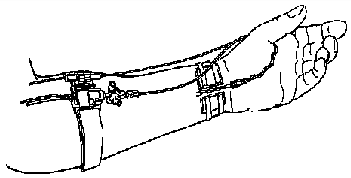
The critical design criteria for fiber optic medical chemical sensors naturally depend on the monitoring location. For measurements external to the body, large sensors can be used. Commercially available accessories for heart lung machines are one example. Providing monitoring for the substantially larger number of critical care patients requires less invasive access. An ideal site for these measurements is the radial artery pressure monitoring line (Figure 1). These lines are routinely installed in approximately 2 million patients per year, providing direct access to the patient's arterial blood and blood pressure.
Figure 1
Several designs have been investigated for coaxial fiber optic and optical monitoring of the arterial blood at this site. Most fall into one of two categories: Ex-Vivo or Indwelling. Each method has distinct advantages and disadvantages. Ex-Vivo sampling is performed by removing a small quantity of blood from the patient for each sample. Some systems perform this sampling automatically at predetermined intervals. The advantages offered by this method include the acquisition of a mixed arterial sample, the flexibility to use larger sensors, no obstruction of the arterial pressure monitoring line except during sampling, and the ability to perform on line calibration checks of the sensors. Disadvantages include the loss of patient blood volume (critical in neonates), potential errors due to gas leakage to and from the atmosphere, the disposal of waste blood, non-continuous measurement, the attachment of apparatus and fluid manifolds to or near the patient, and the loss of blood pressure measurement during sampling. Indwelling measurements are obtained by placing the sensors through the existing arterial catheter into the radial artery. Advantages of this system are continuous measurements, minimal apparatus, and the absence of waste blood or blood loss. Disadvantages of current systems can include a loss of accuracy, distortion or loss of the pressure waveform, high cost, and some installation problems where custom arterial cannulas were required.
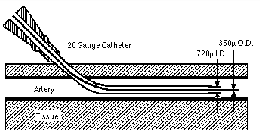
Our investigations centered on developing an optimum design for an indwelling arterial blood gas and pH sensor. The criteria identified as most important to achieve a satisfactory result were smaller size and lower cost. Other important variables were biocompatibility, compatibility with existing arterial catheters, and improved accuracy. The College of American Pathologists specifies an accuracy standard for in-vitro blood gas analyzers of �0.03 pH, �7.5% PCO2, and �7.5% PO2. This standard represents a minimum target. It is generally prudent to exceed this accuracy. The availability of trend information can be of critical assistance to medical personnel even where accuracy is not to this standard. Recent sensors designed by the authors to meet these criteria are 350� in overall diameter. These sensors are small enough to fit through the 720� inner diameter of standard 20 gauge arterial catheters currently in use (Figure 2). This configuration causes only a 24% reduction in the cross sectional area of the arterial cannula. Effects on pressure and pressure waveform monitoring are negligible. The extremely small size also permits installation into the sampling lumen of many other types of catheters.
Figure 2 Low cost was achieved by wavelength multiplexing in a single fiber multiparameter sensor. This eliminates many assembly and component costs. A proprietary fluorescent dye system was synthesized for each parameter. Each dye allows for wavelength separation of its signal from the others. Examination of different portions of the optical spectrum allows for the measurement of multiple parameters through a single fiber. All other materials were selected for biocompatibility based on common medical industry usage. 4. Experimental Procedure 4.1 Tonometered Saline
A saline test solution was prepared by mixing 2.6mM of NaH2PO4, 17.4mM of Na2HPO4, 18mM of NaHCO3, and 140mM of NaCl in 1 liter of distilled water. The solution was mixed well and allowed to stabilize overnight. 15ml of test solution was added to each of five - 20ml glass vials. Grade E fritted glass spargers were inserted through one hole each of 5 two hole size 2 rubber stoppers. The stoppers were then inserted into each vial such that the frit rested within a few millimeters of the bottom. 20ml and 150ml glass vials were used for drift studies.
Certified gas cylinders were obtained in the mixtures shown in table 1. Carbon Dioxide Oxygen Nitrogen Level A 4.0% 21.3% 74.7% Level B 5.5% 17.0% 77.5% Level C 7.0% 13.2% 79.8% Level D 8.5% 9.0% 82.5% Level E 10.0% 5.1% 84.9%
Table 1 Each mixture was connected to a separate vial through a two stage pressure regulator and adjusted to 10cc/min gas flow. The vials were then placed into a rack and immersed in a water bath at 37.0�0.1deg C. Each tonometered solution was allowed to equilibrate for no less than 2 hours. The pH was measured with an Orion combination pH electrode for each vial. Partial pressure was computed using 760mmHg atmospheric pressure less 47mmHg water vapor pressure. The measured pH and computed gas concentration for each level are shown in table 2. Carbon Dioxide Oxygen pH Level A 28.5 151.9 7.43 Level B 39.2 121.2 7.30 Level C 49.9 94.1 7.21 Level D 60.6 64.2 7.15 Level E 71.3 36.4 7.09
Table 2
4.2 Tonometered Bovine Blood
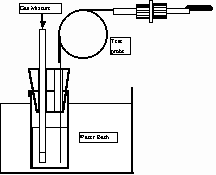
Fresh bovine blood was obtained for testing. Heparin and penicillin were added to prevent clotting and reduce bacterial growth during testing. 15ml of bovine blood was placed in each of five - 20ml vials and tonometered in a similar manner to that described for saline. One drop of antifoaming agent was added to each vial to maintain the solution level. The pH of each vial was measured with an Orion combination pH electrode at the conclusion of the test run. A diagram of the test setup is shown in Figure 3.
Figure 3 4.3 Blood Gas Calibration Ampules
Ciba Corning Certain�+ Blood gas calibration ampules (BGA) for acidosis, normal, and alkalosis were obtained for testing. The gas and pH values listed below in Table 3 were obtained from the batch data sheet accompanying the ampules on the Corning 280 series reference designation. Type Carbon Dioxide Oxygen pH Level 1 Acidosis 69 63 7.16 Level 2 Normal 43 101 7.41 Level 3 Alkalosis 21 146 7.62
Table 3 Each ampule was secured to a test tube rack in the water bath at 37.0�0.1deg C and allowed to stabilize for at least 1/2 hour prior to testing. The top of each ampule was cracked off immediately prior to insertion of the sensor. Equilibration of the ampules at 37�C results in a significant shift in values from the accompanying data sheets. The manufacturers data is based on equilibration at 22�C followed by rapid isolated warming to 37�C in a blood gas analyzer.
5. Instrumentation
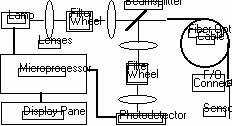
Standard Lightsense Corporation Model FS2 Fiber Optic Sensor Systems were used for all test measurements. This system consists of a Xenon flashlamp, a multichannel filter wheel, beam splitter, Fiber Optic Cable, Solid State photodetectors, and a computer fabricated into a 4.5" x 8.5" x 9.25" battery operated instrument. The instrument interfaces with the sensors through a fiber optic extension cable terminated with inexpensive AMP Optimate connectors. A block diagram of the instrument is shown below in Figure 4.
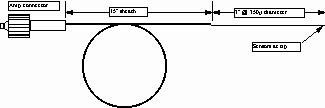
Figure 4 6. Sensors Lightsense Corporation Model P4 350� fiber optic Oxygen, Carbon Dioxide, and pH chemical sensors were used for all tests. Each sensor was 18" long as shown in Figure 5. Two point calibration was performed prior to each test using the Level A tonometered solution as point 1 and the Level E tonometered solution as point 2. No further calibration adjustments were made during any of the testing, including the drift studies.
Figure 5
7. Testing Protocols
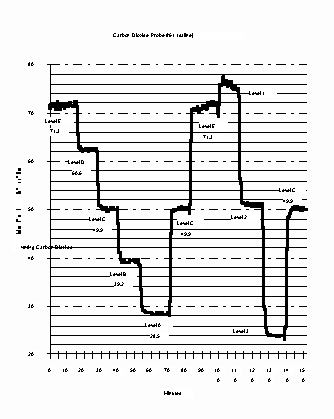
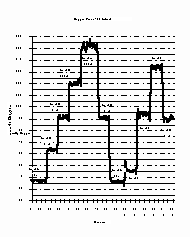
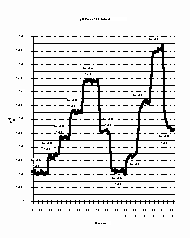
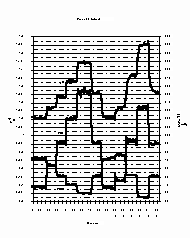
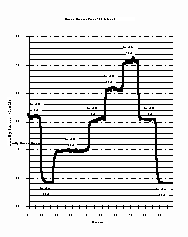
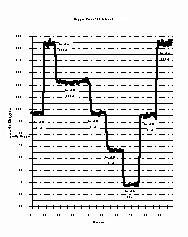
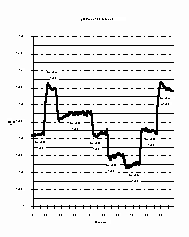
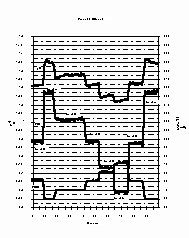
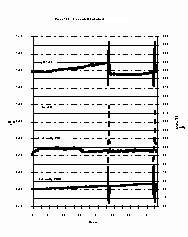
Accuracy testing in saline was performed in the following sequence: 1. The test sensor was two point calibrated in the Level A and Level E saline solutions (14 minutes). 2. The sensor was sequenced through each saline vial from Level E to Level A for 12 minutes each (60 minutes). 3. The sensor was placed back in the Level C and Level E for 12 minutes each (24minutes). 4. The top of each BGA Calibration ampule was snapped off and the sensor inserted for 12 minutes each (36 minutes). 5. The sensors were again placed back in Level C for 12 minutes. Blood testing was performed in a similar manner: 1. The test sensor was two point calibrated in the Level A and Level E saline solutions (14 minutes). 2. The test sensor was placed in bovine blood equilibrated at Level C for 12 minutes. 3. The sensor was sequenced through each Level for approx. 12 minutes. 4. The sensor was placed back in Level C, then Level A for 12 minutes each. Drift testing was performed immediately following a two point calibration in the Level A and Level E tonometered saline solutions. The test sensor was placed in the Level C 20ml saline vial and monitored continuously for 45 hours. The test was then repeated with 150ml vials. 8. Test Results The in-vitro performance of these sensors are shown in the following charts and tables.
Figure 6 Figure 7
Figure 8 Figure 9
Figure 10 Figure 11
Figure 12 Figure 13
Figure 14 Figure 15 Oxygen Sensor Carbon Dioxide Sensor pH Sensor Repeatability: � 2% � 2% � 0.01 Accuracy: � 2% � 2% � 0.03 Drift*: <1 mmHg/day 2 mmHg/day <0.01 /day Response Time** 1 minute 1.5 minute 1.7 minute Table 4 * Tested 72 hours @ 7%CO2,13.2%O2, pH 7.21, 37.0�C ** response time to 90% of step change Table 4 above shows that each of the sensors within the 350� probe monitors its parameter within the accuracy requirements specified in the design criteria. A significant drift of up to 0.02 pH units per hour was found in both saline and blood tests in the 20ml vials (Figures 8, 12, &14 at Level C). This pH drift was not present in the 150ml vial testing (Figure 15), indicating that the loss of saline solution encountered with the smaller vials significantly affects the pH. A smaller PCO2 drift effect was seen during long term studies which was not mitigated by use of the larger test vials. 9. Summary
These results demonstrate the practicality and accuracy of low cost, 350� diameter, single fiber, wavelength multiplexed, fiber optic combination chemical sensors.The sensors not only perform well, but highlighted the flaws in using small volume high gas flow rate tonometering systems. Performance testing in animal models is currently in progress.
10. References 1. Optical Fluorescence and Its Application to a Intravascular Blood Gas Monitoring System, J. Gerich, D. Lubbers, N. Opitz, D. Hannsmann, W. Miller, J. Tusa and M. Yafuso, IEEE Transactions on Biomedical Engineering, Vol. BME-33, No. 2, Feb. 1986, 117-132. 2. Preliminary evaluation of an intra-arterial blood gas system in dogs and humans, B. Shapiro, R. Cane, C. Chomka, L. Bandala, W. Perruzzi, Critical Care Medicine, Vol. 17, No. 5, May 1989 3. Practical perspectives on the in-vitro and in-vivo evaluation of a fiber optic blood gas sensor, D. Hansmann, J. Gehrich, SPIE Vol. 906, Optical Fibers in Medicine III (1988) 4. Progress in the Development of a Fluorescent Intravascular blood gas system in man, C. Mahutte, C. Sassoon, J. Muro, D. Hansmann, T. Maxwell, W. Miller, M. Yafuso, Journal of Clinical Monitoring, Vol. 6, No. 2, April 1990 5. Fiber optic fluorosensor for oxygen and carbon dioxide, O. Wolfbeis, L. Weis, M. Leiner, W. Ziegler, Analytical Chemistry, Vol. 60, No. 19, Oct 1,1988.
|
Send mail to LarryRing@lightsensecorp.com with questions or comments. |